

Myopia surgery has undergone significant evolution in recent years thanks to the incorporation of high-precision technologies such as the femtosecond laser. This type of laser allows for safer, more controlled, and highly personalized procedures within refractive surgery.
Currently, the femtosecond laser is used in advanced techniques such as LASIK and ReLEx SMILE, serving as a key tool in both. Although the goal of these procedures is the same—to correct myopia and reduce dependence on glasses or contact lenses—the way this technology is applied varies in each case.
From Clínica Rahhal, we explain in this article what femtosecond laser for myopia is like, how it is applied in each technique, and the differences between LASIK and ReLEx SMILE procedures.
What Is a femtosecond laser?
The femtosecond laser is an advanced ophthalmic technology that enables highly precise cuts in ocular tissues using extremely brief pulses of energy. These pulses, which occur in one quadrillionth of a second, act in a localized and controlled manner on the cornea, without affecting adjacent structures.
Due to this high level of precision, the femtosecond laser has become a key tool in various areas of ophthalmology. In the field of refractive surgery, it plays a fundamental role in the correction of myopia, as it allows key steps of the procedure to be performed with a high level of accuracy and safety.
Additionally, it is also used in procedures such as cataract surgery, where it enables highly precise automation of incisions and capsulorhexis, as well as in the treatment of certain corneal conditions, such as intrastromal ring surgery for keratoconus.
Advantages of femtosecond laser technology for myopia
The use of the femtosecond laser in myopia surgery has represented a significant advancement in both the precision and safety of the procedures.
Among the main advantages of femtosecond laser technology for myopia are:
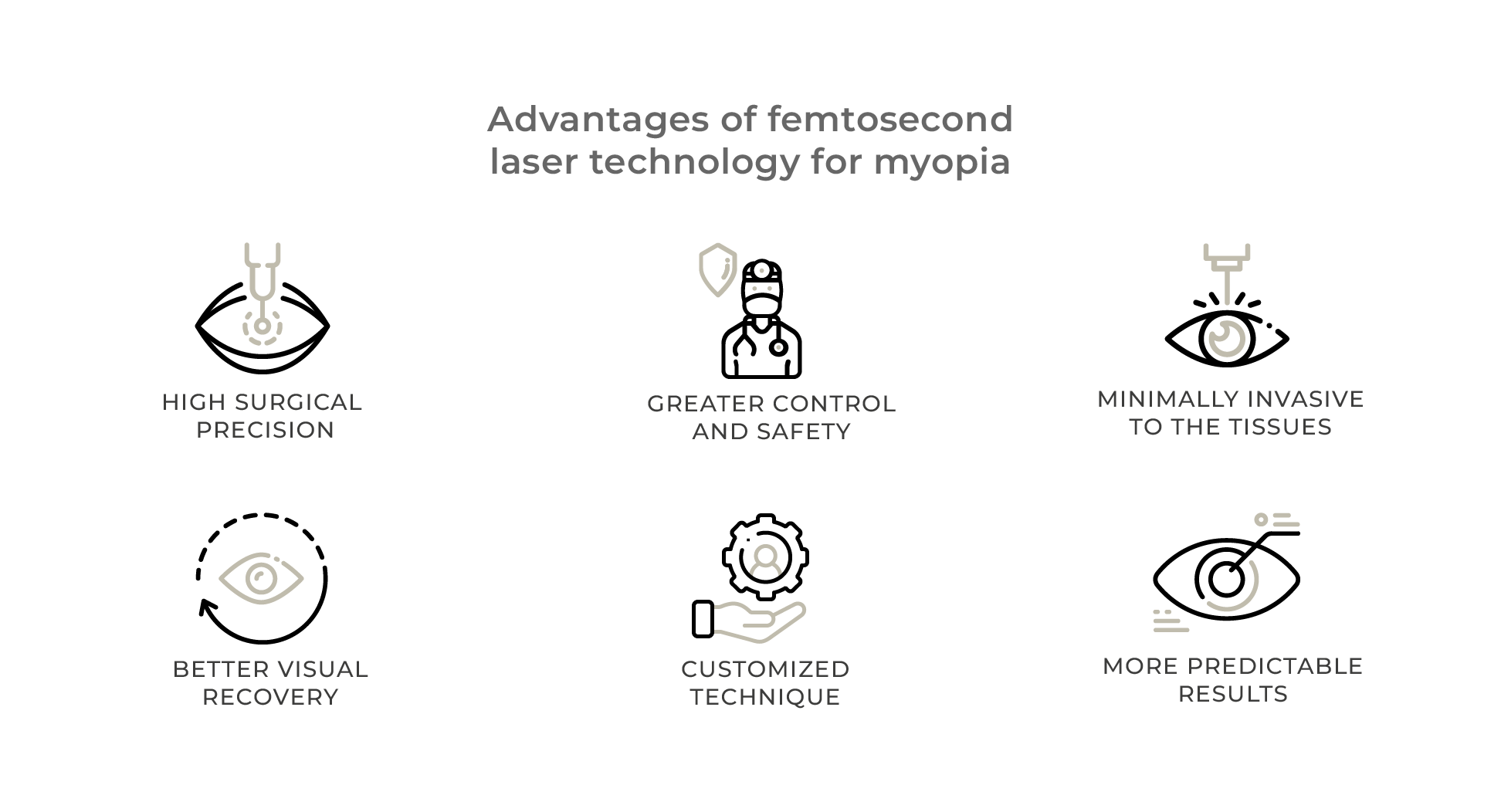
- High surgical precision: enables corneal cuts with micrometric accuracy, allowing for a highly precise execution tailored to each patient’s anatomy.
- Greater control and safety: facilitates the performance of each phase of the procedure in a more controlled manner, reducing variability during surgery.
- Minimally invasive to tissues: acts in a localized way, better preserving the corneal structure and minimizing the impact on surrounding tissues.
- Improved visual recovery: in many cases, its advanced technology promotes faster recovery with less discomfort after the procedure.
- Technique customization: allows the use of different procedures, such as LASIK or ReLEx SMILE, selecting the most suitable option based on each person’s ocular characteristics and needs.
- More predictable results: its high level of control and precision provides more reproducible and stable surgical outcomes, enabling better prediction of visual evolution in both the short and long term.
What is the femtosecond laser used for in myopia surgery?
The femtosecond laser for myopia can be used in key stages of different refractive surgery techniques, all with a high level of precision and control, which helps improve both safety and visual outcomes. Depending on the technique used, the femtosecond laser is applied at a specific step of myopia surgery, adapting to the characteristics of both the procedure and the patient.
It is important to remember that the choice of the appropriate surgical technique should be made by a refractive surgery specialist, who, after conducting a comprehensive evaluation of the eye’s characteristics, will select the most suitable option for each case. The ophthalmologist is responsible for determining the most appropriate treatment, as not all techniques are suitable for every patient, and the safety and effectiveness of the procedure depend on making the right choice.
Below, we explain the main techniques in which the femtosecond laser is used for myopia:
Femtosecond Laser in the LASIK Technique
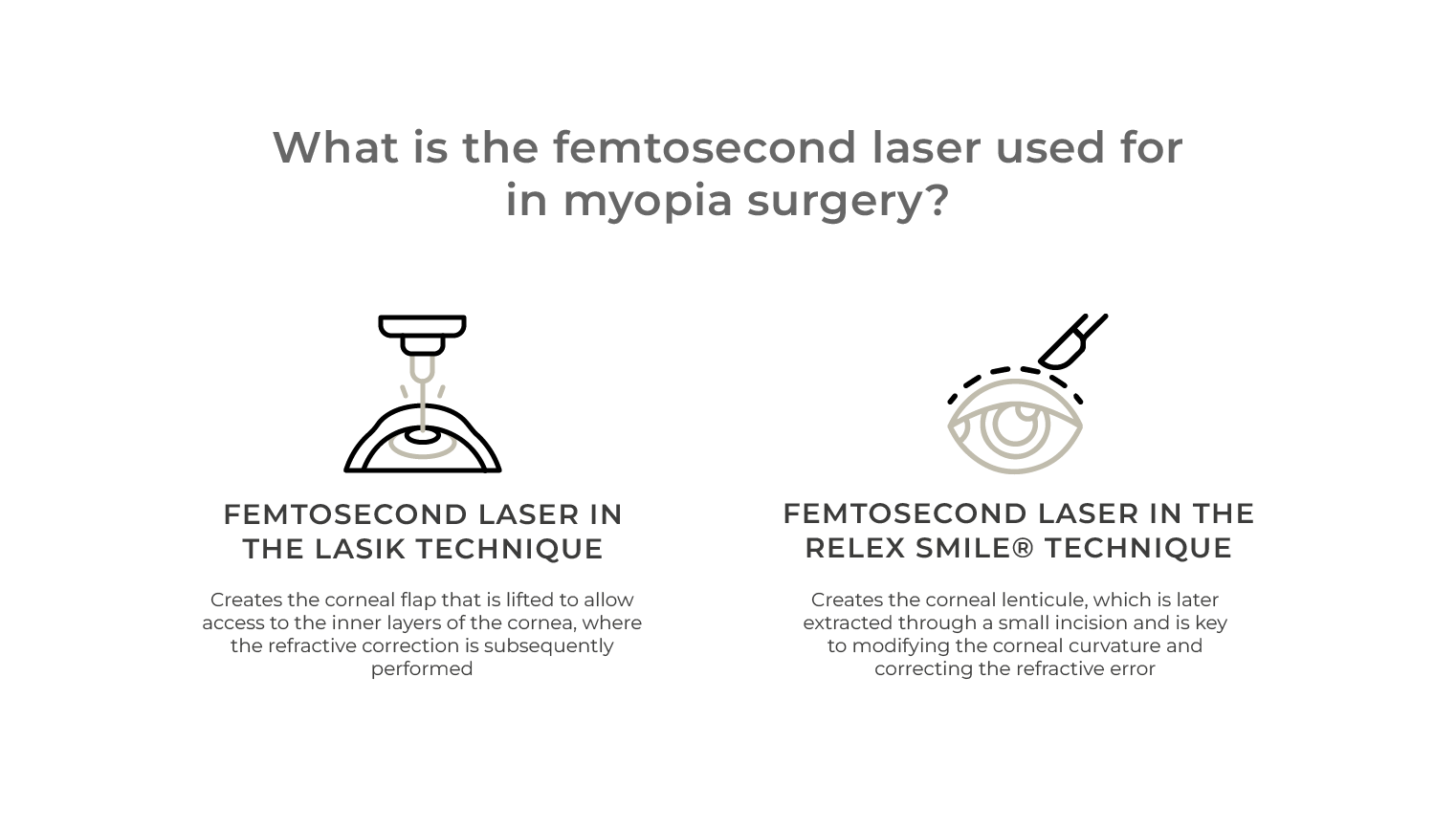
In the LASIK technique, the corneal flap is created using a femtosecond laser, which is the initial phase of the procedure.
This flap is a thin layer of corneal tissue that is lifted to allow access to the inner layers of the cornea, where the refractive correction is subsequently performed. The use of the femtosecond laser in this step allows for greater precision in the thickness, diameter, and position of the flap, improving the safety and control of the procedure.
Femtosecond Laser in the ReLEx SMILE Technique
In the ReLEx SMILE technique, the femtosecond laser is used to create and extract the corneal lenticule, which is the tissue responsible for correcting myopia.
During this process, the femtosecond laser acts within the cornea to generate the lenticule with high precision, which is then removed through a small incision. This step is key within the procedure, as it allows the corneal curvature to be modified and the refractive error to be corrected.
How does femtosecond laser myopia surgery work?
Myopia surgery with a femtosecond laser is an outpatient, quick, and highly precise procedure that is tailored to the surgical technique indicated for each patient.
Although all techniques aim to correct the refractive error to improve vision, the way the procedure is performed varies depending on the selected method. The femtosecond laser is used at key stages of the surgery, allowing essential steps to be carried out with a high level of accuracy and control.
There is no single technique that is better than the others, but rather one that is most suitable for each patient. The choice of technique will be determined by the specialist, who, after a comprehensive evaluation, will decide which option is most appropriate to ensure the best possible results.
Below, we explain how the procedure is performed in the main techniques that use femtosecond laser technology:
Myopia Surgery with LASIK
In the LASIK technique, the procedure is performed in a precise and structured manner, combining the use of the femtosecond laser and the excimer laser to correct myopia, while also allowing the correction of hyperopia and astigmatism.
Myopia surgery with LASIK is carried out in the following steps:
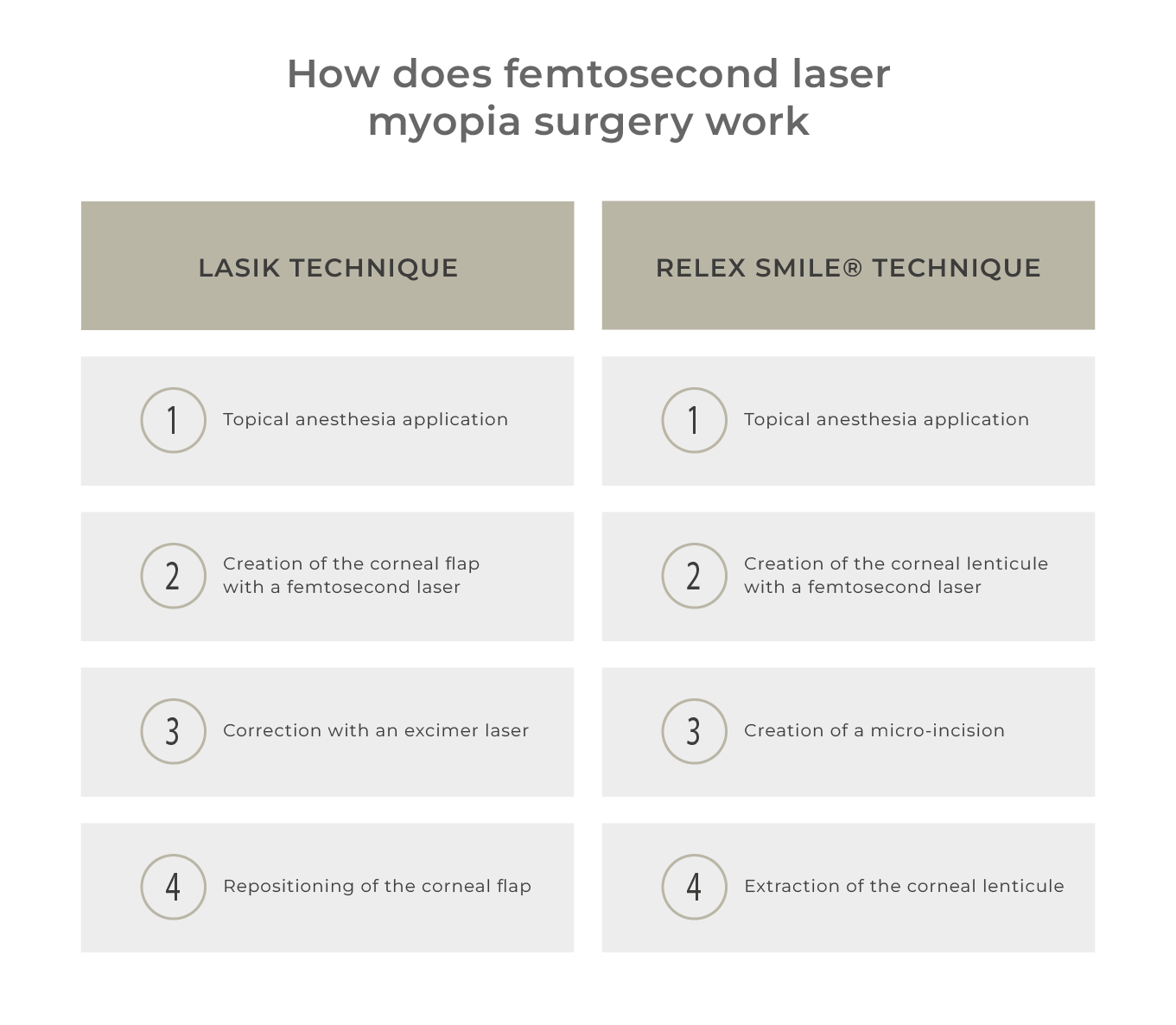
- Application of topical anesthesia: anesthetic eye drops are administered to prevent discomfort during the procedure. The patient remains awake throughout the process, with no need for general anesthesia.
- Creation of the corneal flap with a femtosecond laser: the laser creates a thin layer of corneal tissue, which is gently lifted to access the inner layers of the cornea.
- Correction with excimer laser: the excimer laser is used to reshape the cornea, correcting myopia, hyperopia, and astigmatism.
- Repositioning of the corneal flap: once the correction is completed, the flap is repositioned in its original place, where it naturally adheres without the need for sutures, initiating the recovery process.
Myopia Surgery with ReLEx SMILE®
In the ReLEx SMILE® technique, the procedure is performed exclusively using a femtosecond laser, acting directly within the cornea to correct the refractive error. In addition to correcting myopia, it can also correct astigmatism if needed.
Myopia surgery with ReLEx SMILE follows these steps:
- Application of topical anesthesia: anesthetic eye drops are administered to ensure the patient feels no discomfort during the surgery. The procedure is performed with the patient awake, without the need for general anesthesia.
- Creation of the corneal lenticule with a femtosecond laser: the femtosecond laser is used to create a corneal lenticule within the cornea, with the precise thickness and shape required to correct myopia and/or astigmatism.
- Creation of a micro-incision: a small incision of a few millimeters is made in the cornea, just large enough to allow the extraction of the previously formed lenticule.
- Extraction of the corneal lenticule: the surgeon removes the lenticule through the incision, reshaping the cornea and achieving the correction of myopia and astigmatism.
Frequently Asked Questions about the femtosecond laser for myopia
We know that undergoing femtosecond laser surgery for myopia, as it involves advanced technology, can raise questions.
For this reason, below we answer the most common questions our patients ask during consultations, so you can have clear information before starting the procedure:
Is femtosecond laser myopia surgery painful?
No, femtosecond laser myopia surgery is not painful. The procedure is performed with topical anesthesia in the form of eye drops, so the patient does not feel pain during the intervention. It is possible to notice slight pressure or mild discomfort after the surgery, but these are usually temporary and disappear in a short time.
How long does femtosecond laser myopia surgery take?
Femtosecond laser myopia surgery is quick and typically takes between 10 and 15 minutes per eye, although the total time in the operating room may be slightly longer due to prior preparation and post-procedure checks. It is an outpatient procedure, so the patient can return home the same day.
Who can undergo femtosecond laser surgery for myopia?
In general, people over 18 years old with diagnosed myopia and a stable prescription can undergo femtosecond laser surgery. However, it is essential to perform a comprehensive ophthalmological evaluation to assess factors such as corneal thickness, overall eye health, and each patient’s individual characteristics before determining the most appropriate technique.
What is recovery like after femtosecond laser myopia surgery?
Recovery is usually quick, as it involves advanced techniques such as LASIK or ReLEx SMILE. Many patients experience visual improvement within the first 24–48 hours, although full stabilization may take a few days or weeks. During this period, it is important to follow medical instructions to ensure proper healing and optimal results.
What is the cost of femtosecond laser treatment for myopia?
The price of femtosecond laser treatment for myopia may vary depending on the technique used, the degree of refractive error, and the required preoperative assessment. For this reason, it is advisable to undergo a personalized evaluation to determine the most suitable treatment in each case.
At Clínica Rahhal, we carry out a comprehensive and personalized assessment to evaluate each situation and provide a tailored quote based on the specific characteristics of each patient.

Dr. Rahhal 
Medical content supervised by Dr. Rahhal
Graduated in Medicine from the University of Valencia, having completed her specialization in Ophthalmology in the Ophthalmology Department at Hospital La Fe. She has numerous national and international publications in the field of ophthalmological disease research.
Book an appointment for your femtosecond laser myopia surgery in Valencia
Now that you know what femtosecond laser surgery for myopia is like, if you’re interested in improving your vision, you can book an appointment at Clínica Rahhal so that our medical team specialized in refractive surgery can evaluate your case in a personalized way.
You can call us at 963 527 727 or leave your details in the following form, and we will contact you as soon as possible to provide more information or schedule an appointment with one of our specialists.


